

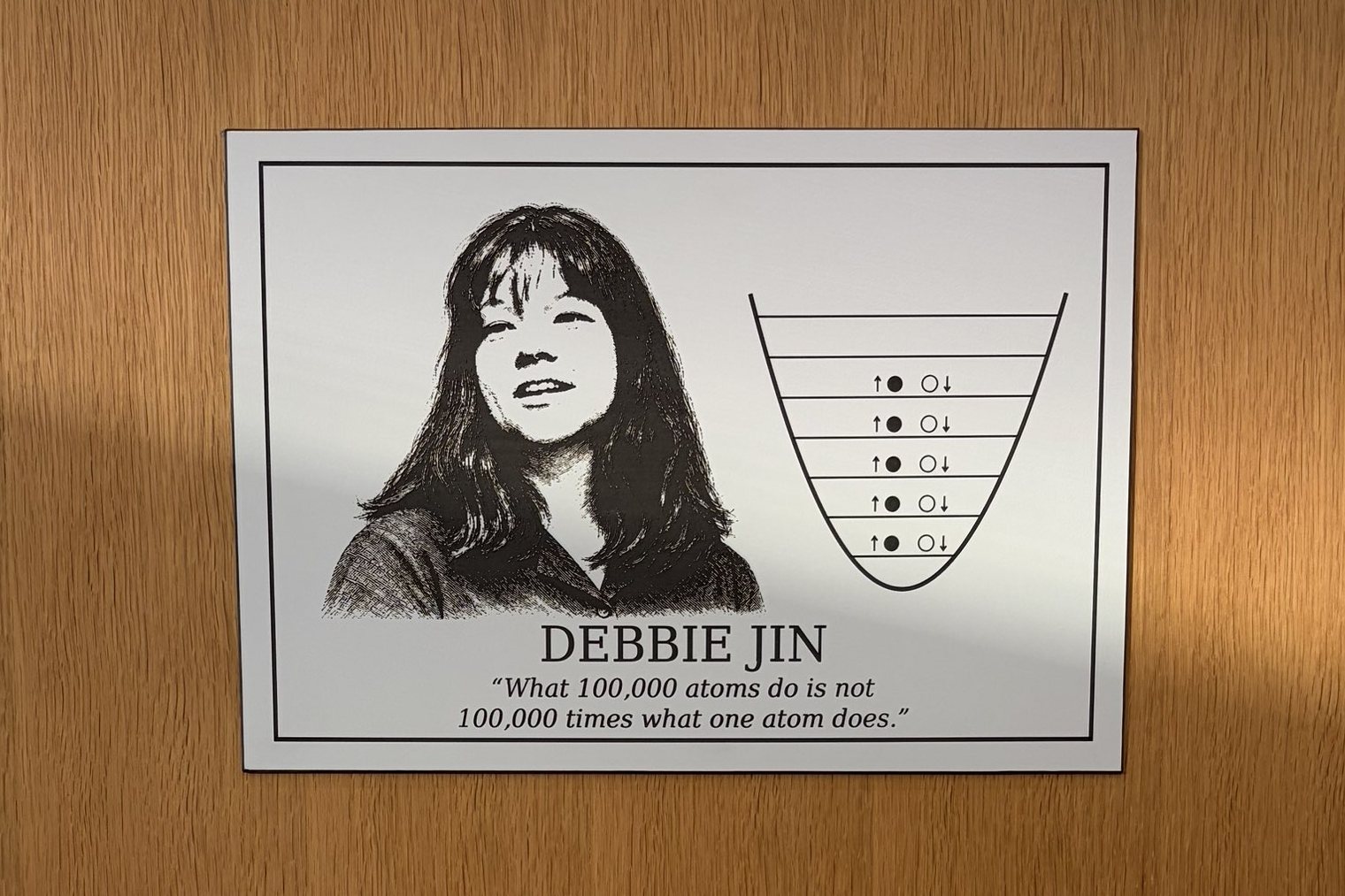
What used to be the IQOQI library is now the Debbie Jin Salon: on 24 November 2026, IQOQI Innsbruck named its library the “Debbie Jin Salon”. The room honours the pioneering experimental physicist Deborah S. Jin (1968–2016), whose work founded the field of ultracold Fermi gases. The room is meant to be a place for what she stood for: curiosity, open exchange and encouraging one another.
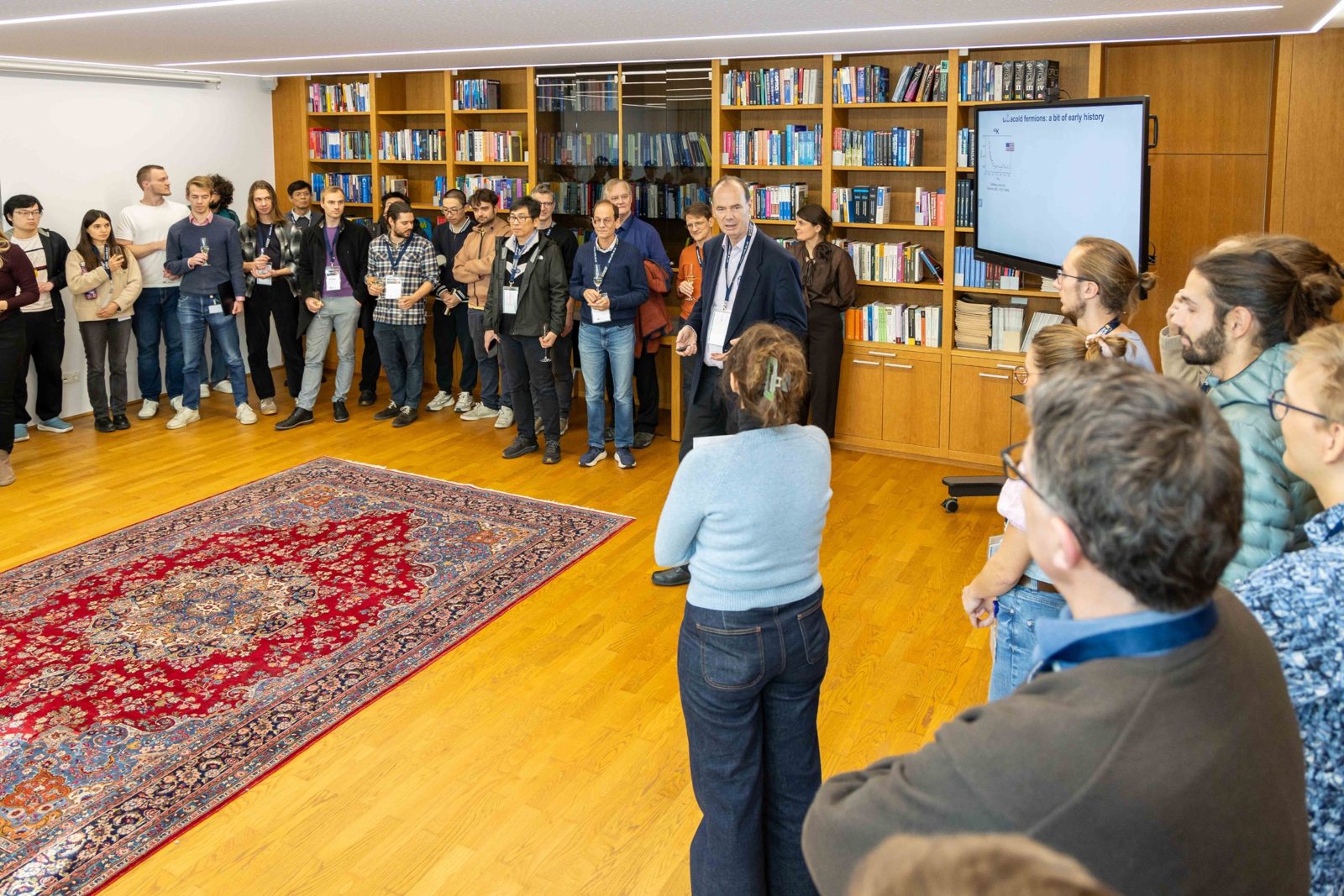
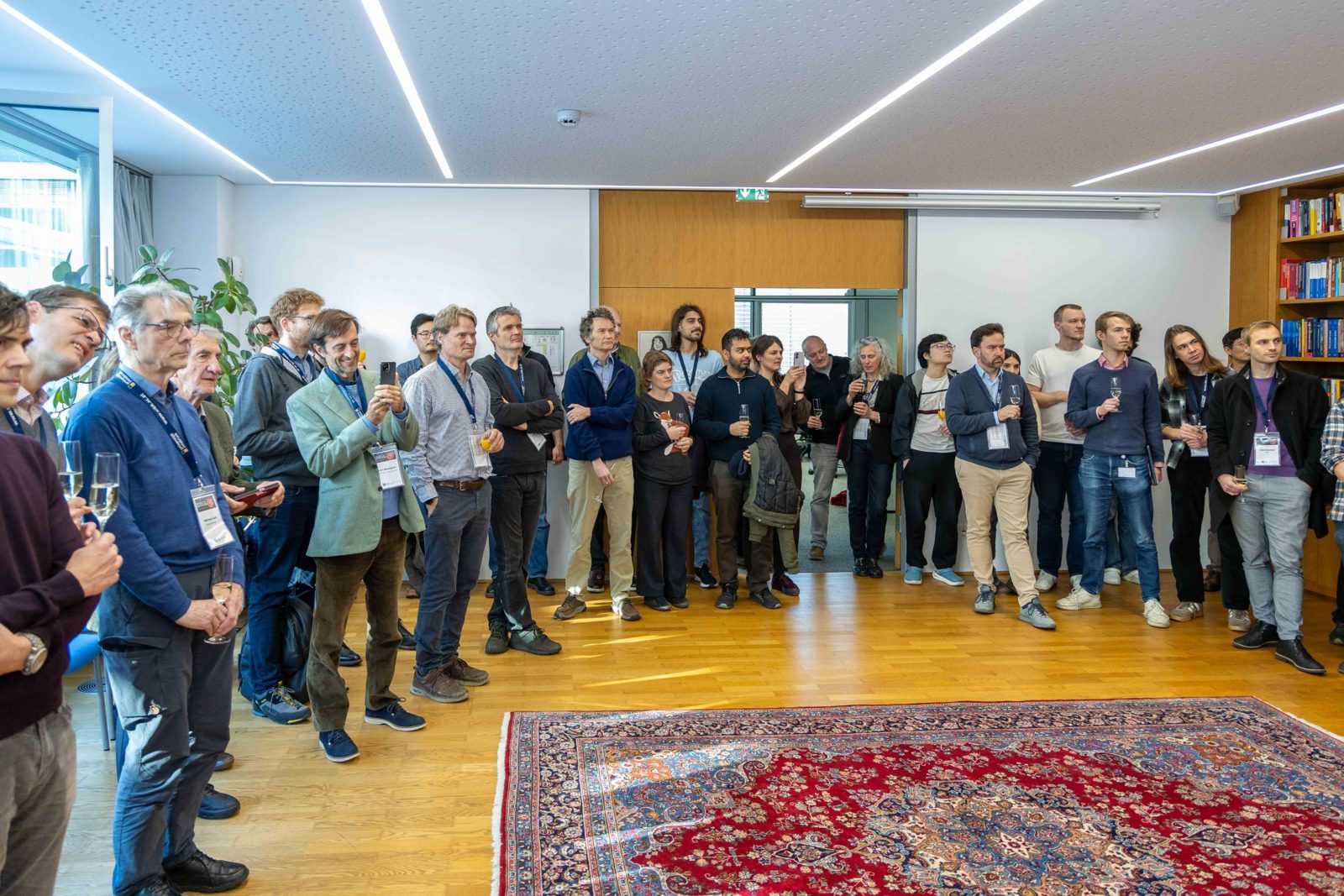
The salon was inaugurated during the symposium in honour of Rudolf Grimm, whose Innsbruck group pursued the same scientific questions as Jin's group at JILA in Boulder in the early 2000s. Grimm opened the ceremony by recalling the many links between IQOQI and Debbie Jin, and Jun Ye, her close colleague at JILA, spoke about her research. Nobel laureate Eric Cornell, in whose lab Jin had begun her work in Boulder, sent a video message. "It seems very appropriate to me to name a room such as this in Debbie's memory," he said.
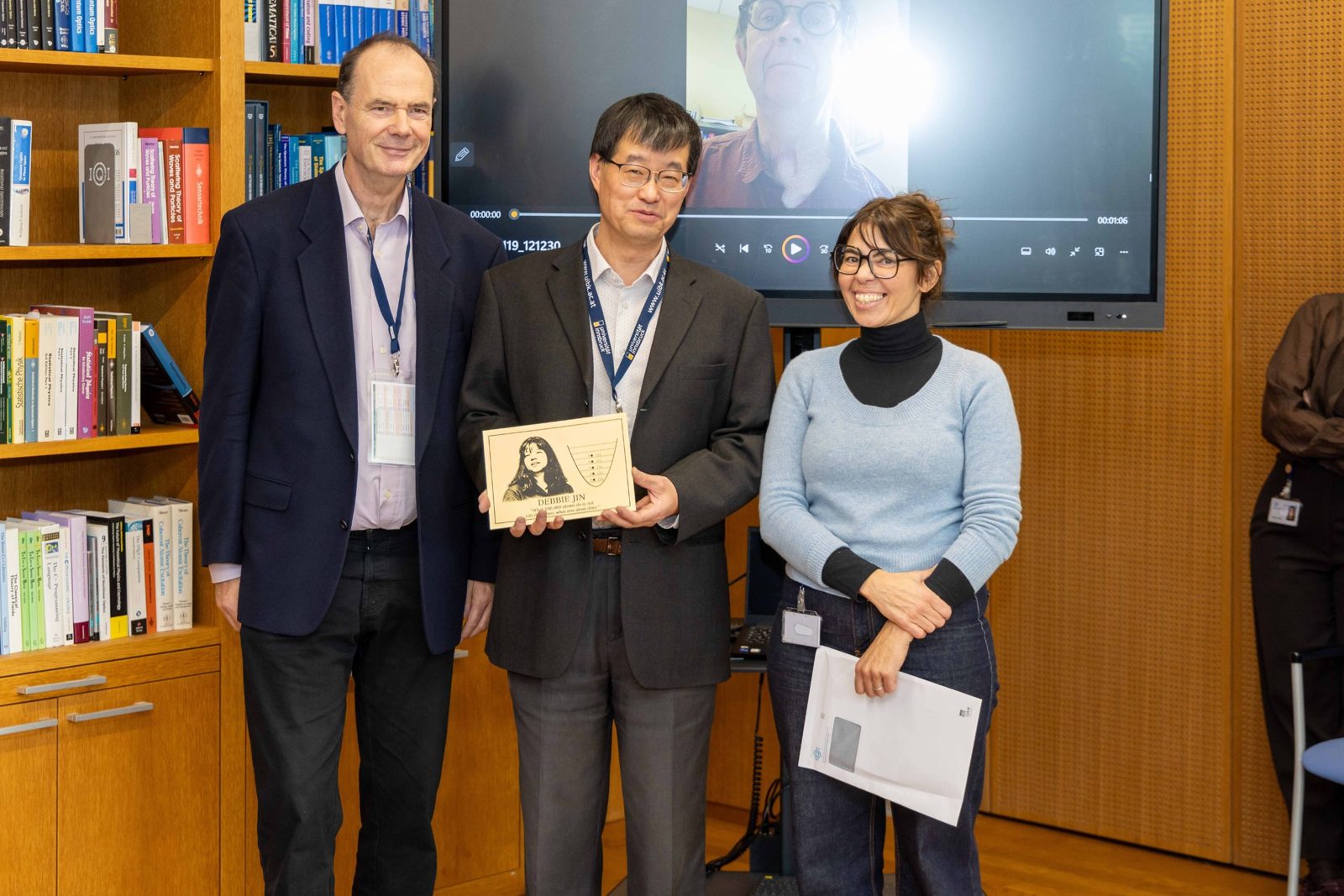
A plaque in honour of Debbie Jin; on screen, Eric Cornell's video message. Photo: David Jordan
"In her too-short life, Debbie Jin had a disproportionate effect on our field. Her example as a mentor and role model for a generation of young scientists is an example we can all continue to follow in the future."
Francesca Ferlaino describes Jin as one of those rare individuals "whose creativity, courage, and scientific vision opened an entirely new direction of research."
Scientific breakthroughs
Particles belong to two fundamentally different families: bosons and fermions. Bosons can occupy the same quantum state, which in 1995 made it possible to cool bosonic atoms into the first Bose–Einstein condensate. Fermions, by contrast, obey the Pauli exclusion principle: identical fermions cannot share a quantum state, and at very low temperatures they barely collide, yet those collisions are exactly what evaporative cooling relies on.
In 1999, Jin found an ingenious way around this obstacle. Together with graduate student Brian DeMarco, Deborah Jin achieved the first degenerate Fermi gas of atoms. By exploiting their innovative concept of evaporative cooling between different spin states, they cooled about a million potassium atoms to temperatures near 300 nanokelvin (less than one-third of a millionth of a degree above absolute zero). Unlike bosons, which can occupy the same quantum state and form a Bose–Einstein condensate, fermions obey the Pauli exclusion principle and occupy different energy states. This characteristic makes it particularly challenging to reach quantum degeneracy.
Only a few years later, in 2003, Deborah Jin and her team achieved a groundbreaking milestone by demonstrating Bose–Einstein condensation of molecules formed from fermionic atoms. Around the same time, the groups led by Rudolf Grimm in Innsbruck and Wolfgang Ketterle at MIT independently achieved similar breakthroughs. Together, these pioneering experiments paved the way for the experimental exploration of the BEC–BCS crossover, which describes the continuous transition from tightly bound molecular pairs to the loosely bound Cooper pairs characteristic of BCS superfluidity. In 2004, Jin's group further demonstrated the condensation of fermionic atom pairs in the crossover regime. "It was an extraordinarily exciting period in our field," Ferlaino recalls.
Jin's curiosity did not stop there. In 2008, together with her JILA colleague Jun Ye, Jin reached another long-sought goal: an ultracold gas of polar molecules. Rather than cooling molecules directly, they combined ultracold potassium and rubidium atoms and used precisely tuned laser pulses to coherently convert them into molecules in their lowest-energy state. This achievement made it possible to study chemical reactions at temperatures near absolute zero and opened up a rich field for exploring exotic phases of matter.
Ferlaino also knew Jin as a collaborator. Together with John Bohn and colleagues in Innsbruck and Boulder, they studied how magnetic fermionic atoms collide, work published in Physical Review Letters in 2014. "This connection makes the dedication of a room at IQOQI to Debbie particularly meaningful to me," she says.
Mentor and role model
Jin reached the very top of a field long dominated by men: at 36 she was elected to the US National Academy of Sciences. Yet her own success was never the whole story. "Especially in recent years, she devoted herself to promoting women in physics and science through groups, talks, and advocacy," reads a tribute published in Science. For Ferlaino, too, she was a role model and a personal inspiration: "She actively supported younger scientists, encouraged women at different stages of their careers, and helped create an environment in which talent, curiosity, and determination could flourish." Many of the people Jin trained, among them Cindy Regal and Kang-Kuen Ni, now lead research groups of their own, and the American Physical Society's Deborah Jin Award honours outstanding doctoral research in atomic, molecular and optical physics in her name.
The salon carries this legacy into everyday life at the institute: a room where people meet, discuss science, share what they know and inspire one another. "In a way, this is perhaps the most fitting tribute we can offer: a space dedicated to scientific curiosity, intellectual freedom, and the human connections that make great science possible," says Ferlaino. "It will be a place to keep her spirit, her example, and her inspiration alive for future generations."
About Deborah S. Jin (1968–2016)
Deborah Shiu-lan Jin was born in 1968 in Stanford, California, and grew up in Indian Harbour Beach, Florida, in a family of physicists. She graduated magna cum laude in physics from Princeton University in 1990 and earned her PhD at the University of Chicago in 1995 under Thomas F. Rosenbaum, exploring anisotropies in heavy-fermion superconductors such as UPt3. She then moved to JILA in Boulder as a postdoctoral researcher with Eric Cornell and Carl Wieman, where she led some of the first detailed studies of the newly created Bose–Einstein condensates.
In 1997 she founded her own research group at JILA, where she remained for the rest of her career as a NIST physicist, JILA Fellow and adjoint professor at the University of Colorado Boulder. Her work earned her numerous honours, among them the APS Maria Goeppert-Mayer Award (2002), a MacArthur Fellowship (2003), the I. I. Rabi Prize (2005), the Benjamin Franklin Medal in Physics (2008), the L'Oréal-UNESCO For Women in Science Award (2013), and the Comstock Prize in Physics and the IOP Isaac Newton Medal (both 2014). In 2005 she was elected to the US National Academy of Sciences. Debbie Jin died on 15 September 2016 in Boulder, at the age of 47.
The atom*innen memorial poster
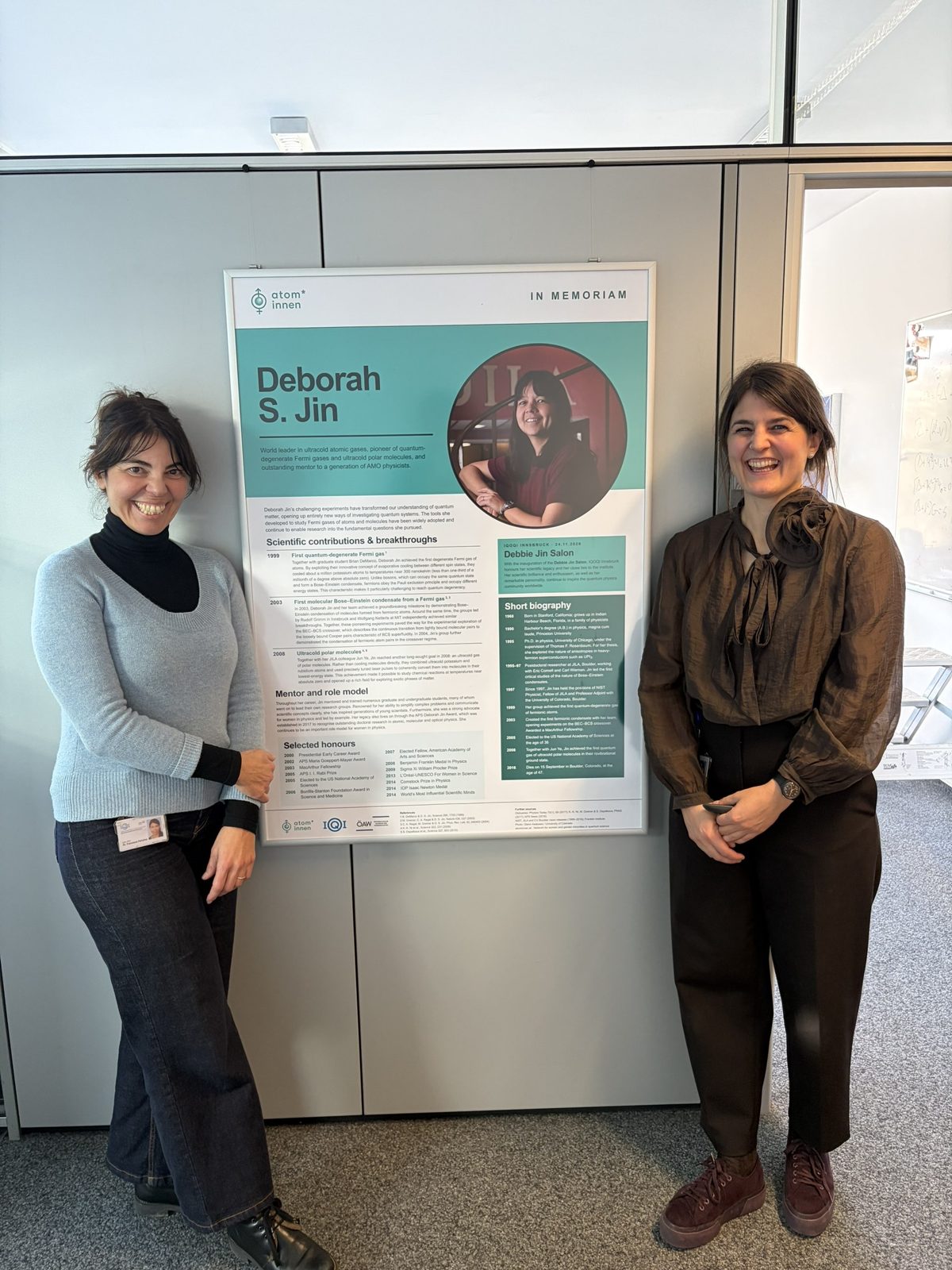
For the occasion, we at atom*innen designed a memorial poster that traces Debbie Jin's life, her scientific breakthroughs and her role as a mentor. Here is the poster to download:
Read and see more
More photos of the inauguration: IQOQI website
Obituary of Debbie Jin by John Bohn: Physics Today