

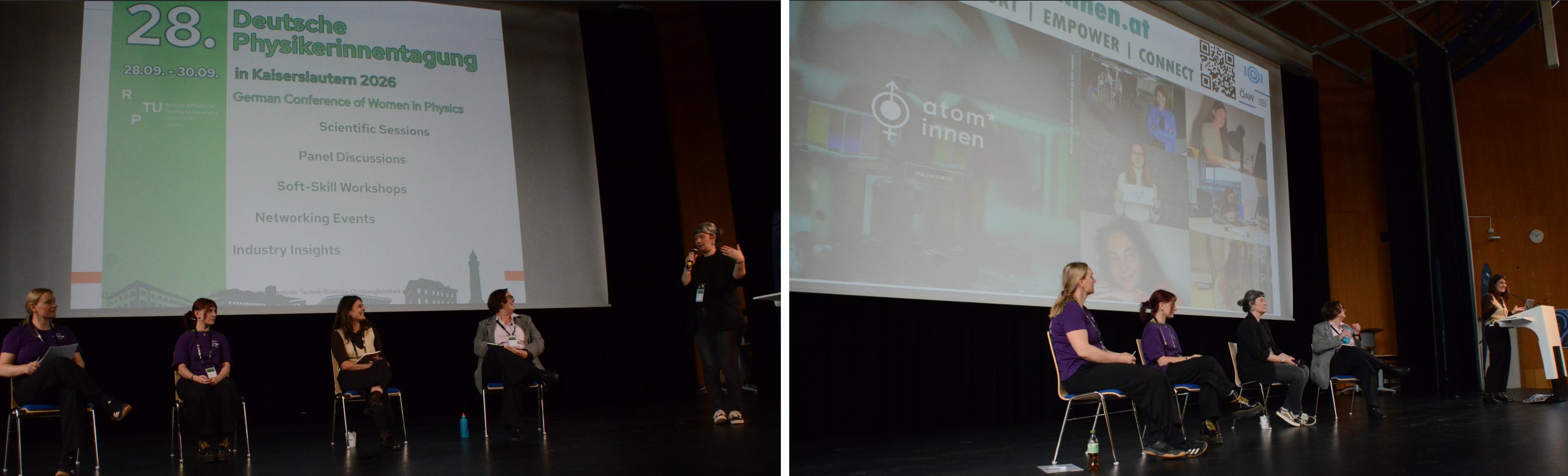
On 29 September 2026, atom*innen took part in two sessions at the German Women in Physics Conference (Deutsche Physikerinnentagung, DPT) at Rheinland-Pfälzische Technische Universität Kaiserslautern-Landau (RPTU). Our Gender Officer Karoline Irschara spoke on a panel about equal opportunities measures. She also co-presented a contributed talk on diversity in physics.
About the conference
Women physicists in Germany have been meeting regularly for scientific and societal exchange since the 1990s. In 1997, participants in Berlin formally established the conference as the Deutsche Physikerinnentagung. This development helped pave the way for the founding of the Working Group on Equal Opportunities (Arbeitskreis Chancengleichheit, AKC) of the German Physical Society (Deutsche Physikalische Gesellschaft, DPG) in 1998. Since 2019, the DPT has run as an independent and successful conference, and the AKC supports each year's local organising team. We work closely with the AKC, most recently on our campaign PhysicsCounts. The campaign highlighted the gender imbalance in the prizes the DPG awards to women and men.
The DPT brings together scientists, students, educators and professionals from all areas of physics, career stages and sectors. Alongside its scientific programme, it offers career events, soft-skills workshops, opportunities to meet representatives from research and industry, and plenty of space for networking.
Panel: Equal Opportunities Measures
Karoline joined Dr. Stefanie Wittich and Lee Ann Schneider (Philipps-Universität Marburg), Anna Voigt (Nationales MINT Forum, Kompetenzzentrum Technik-Diversity-Chancengleichheit e. V.) and Natascha Compes on the panel. They discussed which measures are needed today to advance gender equality in physics and across STEM. They also asked which measures actually work, which are overrated and what best practice looks like.
One message kept coming up: sustainable change takes more than good intentions and all of this is not just a women's issue. We needs evidence-based approaches, accessible opportunities, strong cooperation between different actors, and spaces where people can connect and support one another.
The panel highlighted several key elements for advancing equality in physics:
- accessible entry points to physics, research and STEM opportunities
- safe opportunities for meaningful exchange
- measures informed by data and educational research
- collaboration between research, education, policy and civil-society initiatives
- and, crucially, strong networks
Contributed Talk: "Why Diversity Makes Better Physics"
These themes were also at the heart of our talk "Why Diversity Makes Better Physics". Karoline gave it together with Ulrike Böhm (ZEISS Group / DPG Working Group on Equal Opportunities). The talk presented data on gender representation in physics and discussed the factors behind persistent disparities.
Research consistently shows that diverse teams foster creativity, productivity and innovation, both in academia and in industry. Yet large gender imbalances persist in physics, especially at senior career levels. In Germany, for example, women hold only around 12% of physics professorships. So diversity is not only a question of fairness and equal opportunity. It is essential for better science. A scientific community with a wider range of perspectives is better equipped to ask new questions, develop innovative ideas and tackle complex challenges.
Our contribution
With atom*innen, we want to help drive this change. We make women and gender minorities in quantum physics more visible and connect them across institutions and career stages. We also create opportunities for exchange, support and collaboration.
We would like to thank the organisers, our fellow panellists and speakers, and everyone who joined the discussions for the valuable exchange and inspiring perspectives.