

Prof. Annabelle Bohrdt talks about what happens when many quantum particles interact, building bridges between cold-atom models and real materials, and why there is no simple fix for gender bias in physics
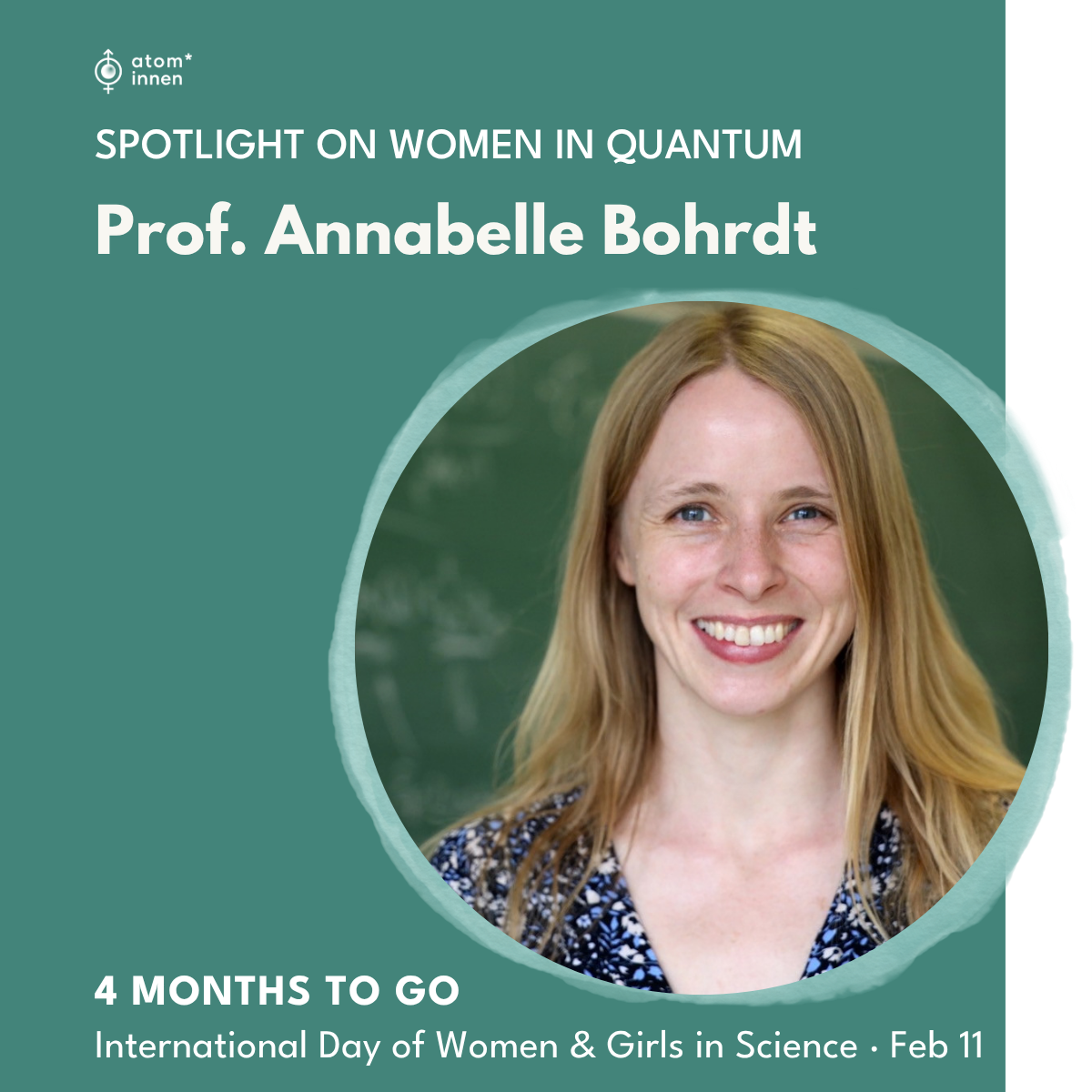
Annabelle Bohrdt is a theoretical physicist at the LMU Munich in Germany. She obtained her doctoral degree from Technical University Munich (Germany). During her PhD, Annabelle spent two years as an exchange student in the group of Eugene Demler at Harvard. From 2021 to 2023, she was an independent ITAMP (Institute for Theoretical Atomic, Molecular, and Optical Physics) postdoctoral fellow at Harvard University. From 2023 to 2025, she was a professor for theoretical physics at the University of Regensburg, Germany. Since 2025, she is working at the LMU Munich.
In her research, she is aiming for a microscopic understanding of strongly correlated quantum systems by developing new analysis tools: She combines numerical methods, intuitive physical pictures, close collaboration with quantum simulation experiments, and machine learning techniques.
PHOTO CREDIT: Katharina Herkommer | University of Regensburg
Dear Professor Annabelle Bohrdt, it is a great honor to talk with you today! Your career is so impressive. Can you tell us a little bit about how it started – what inspired you to become a physicist?
Physics and chemistry were my favorite subjects at school. I initially chose to study biophysics because I found the idea of learning from nature and cleverly engineering things fascinating, and because it seemed more interdisciplinary and exciting than physics alone. However, I soon realized that I didn't enjoy doing experiments myself and that I was only ever scratching the surface. This made me switch to theoretical physics, as I found that I enjoyed the physics part the most anyway. Theoretical physics was therefore the obvious choice for me, even though it initially seemed rather dry and even somewhat scary. But to get to the core of things has fascinated me from the beginning.
There are so many different areas of physics. Why did you choose quantum physics?
Honestly, it was largely a coincidence. When I was an undergraduate, I started working as a research assistant in a condensed matter theory group and thought, 'This is fun; I'll keep going.' There was no grand plan. I just kind of slid into it. But perhaps that's a reassuring message for young people: You don't always need a master plan from the outset.
Can you give us an idea of what you're currently working on?
Broadly speaking, my research focuses on quantum many-body theory. We ask: what happens, or what could happen, when many quantum particles interact with each other? This is fascinating in itself. You can compare it with a flock of birds or a shoal of fish, for example, where the collective behavior produces emergent phenomena that you would never expect from a single individual. With quantum particles, even stranger and more unexpected things can happen. Due to the quantum nature of these things, they can essentially be in a vast superposition of different states, making everything much harder to describe.
Currently, we are trying to establish a closer link between the relatively clean model systems we usually examine and real materials. For instance, we work extensively with cold atoms and optical lattices, as these can realize a given model system very cleanly and effectively. Our main motivation for studying such models is that we hope to describe real quantum materials. One of our group's main focuses is unconventional superconductors – materials that conduct electricity without any resistance. We would like to understand why this happens. To achieve this, we reduce the real material to the 'simplest' possible model while ensuring that we do not lose the essential physics in the process. We are looking for a systematic connection between the material we want to describe and the simplified model that we can solve, to ensure that we capture all the necessary information about this material.
Could you give us an example?
For example, we have these materials and their properties, which we are trying to describe using simple models. Electrons move around and interact with the long-range Coulomb repulsion tail. We normally don't like to take these long-range tails into account because they make our numerical simulations more difficult. They can also complicate quantum simulations and analytical theories. There's some reason to believe that they are somewhat screened away, but definitely not fully. What we're trying to figure out now is how much of this we can throw away without losing the physics we are trying to describe.
What does your day-to-day life as a physics professor look like?
There are many different activities. As well as conducting my own research, I spend a lot of time in meetings with my students, where we discuss our next steps and I receive regular updates. Then, of course, there's teaching. This semester, I am running a seminar on machine learning for quantum systems, which is great fun as the students are very engaged.
Another part of my job involves reading papers and writing reports. Grant applications have also taken up a huge amount of time over the past few years, as I initially had to do a lot of revision work. That's better now, though, and it's great to have some grants. Of course, there is also quite a lot of bureaucratic work. This includes forms, administration, and organizing events with visitors or external collaborators.
I imagine that being a scientist can sometimes be tough. What are some of the challenges one may face, and how important is it to be able to deal with failure in science?
In science, we are used to things not working as planned. This is an interesting topic for me because, as a professor, I supervise a lot of students and I am usually optimistic that things will work out in the end. As a student or at an earlier stage in your career, it can be tough at times, and you may become more frustrated if things don't work out. I think it's important to look at things from different perspectives and to step back at times to see the bigger picture. It is important to me to maintain my motivation and let my students know that we will find a way.
Atom*innen is a platform dedicated to empowering women in quantum science. In your experience: Has your gender affected your career path?
Overall, I’ve been pretty lucky, as I haven’t experienced any major direct disadvantages. However, there have been some moments and situations that have stuck with me, in which I’ve noticed gender playing a role. For instance, when studying physics, you often work in teams. During one such team exercise, I was working with a male partner on a computer-based experiment. For no apparent reason, he simply assumed that he was better suited to the task because it involved a computer. There are many situations like this, where men apparently consider themselves more qualified, and where it’s tacitly expected that women are less competent. This may not be a direct disadvantage, nor is it intentional, but it does happen.
Another example: during a job interview, one of the interviewers remarked that I would definitely get pregnant (again, because I already have two children), which would make things difficult. Situations like these make it clear that there's still a difference in how you and your male colleagues are perceived. We need to address this on many levels. That said, I think we're currently seeing a slight upward trend in enrolment numbers, and there are also more female professors now than when I started studying physics. Progress is being made, but very slowly.
How do you approach this in your own research groups?
Mainly, I try to create an atmosphere in which everybody can feel comfortable and thrive. I also pay very close attention to potential biases when interviewing and hiring. To give you an example: I was looking for new PhD students to join my group this year, so I went through many applications including recommendation letters. Recommendation letters for female applicants on average tended to be more measured and less effusive. Supervisors need to be aware of this and consider what constitutes actual skills and what constitutes self-presentation. I often hear that it is difficult to find female students. Personally, I consider myself lucky that I haven't had any trouble finding many excellent female students so far.
How important are female role models?
I think they are very important. It's not so much about saying "I want to be like her", but more about how normal it feels to see women in certain roles. For example, after watching the video of the Artemis II rocket launch earlier this year, my five-year-old drew a picture of the astronaut and depicted her as a woman completely naturally. For her, it wasn't even a question. That's exactly what visibility achieves, and it made me feel very optimistic.
How important is it to network with other women in science?
It's certainly very important and beneficial to know other female scientists and have a network. However, I think there are two things to be careful about. Firstly, women-only networking events can upset some men, and I don't think it's helpful to deepen that divide. Secondly, time is finite. If you're a PhD student, you need to conduct research, present at conferences and build your reputation in your field. In our field, there are already so few women that at a women-in-physics conference, you might not meet many people working on the same or related topics as you. Therefore, you must think carefully about where your time is best spent and whether attending a general conference in your own community would be more beneficial.
If you could change a few things to improve today's situation for women in physics, what would they be?
I think this is one of the most difficult questions, and I'm always skeptical when people expect a simple answer, such as 'We'll organize a girls' day out and that will solve everything'. The real problem is that many different factors are at play and they all need to be addressed. It's not just one thing; it's a broader societal issue. The things you're told as a child, the things you see growing up, and the stereotypical expectations that other people have at every stage of your career all play a part. While there's always something to be gained from girls' days, mentoring and buddy programs, there's no single solution to this complex issue.
What advice would you give to women who are considering a career in quantum physics?
Don't get discouraged easily – if you're enjoying it, stick with it! For me, it was always clear that if it didn't work out or if I lost my enjoyment of it, I would also be happy to try something else. I think this mindset helped me a lot in not giving up. There are a lot of rejections, whether of papers, job applications or people telling you certain things or creating an atmosphere where you are not appreciated. The most important thing is not to be easily discouraged. If you're enjoying it, you should go for it.
Dear Prof. Annabelle Bohrdt, it was a great pleasure to talk with you. Thank you very much for sharing your perspective with us!
If you want to learn more about Annabelle Bohrdt, you can check:
- Annabelle Bohrdt - professor at LMU
- Bohrdt Group
- Personal Homepage
- Meet ITAMP Alumni - Interview with Annabelle Bohrdt
- Video: AT Navigation überspringen Erstellen 3 Avatarbild Early Career Scholars at the University of Regensburg: Annabelle Bohrdt
Author: Karoline Irschara
published on 2026-10-11