

Professor Monika Ritsch-Marte talks about trapping cells with light and sound, and her tireless advocacy for women in physics
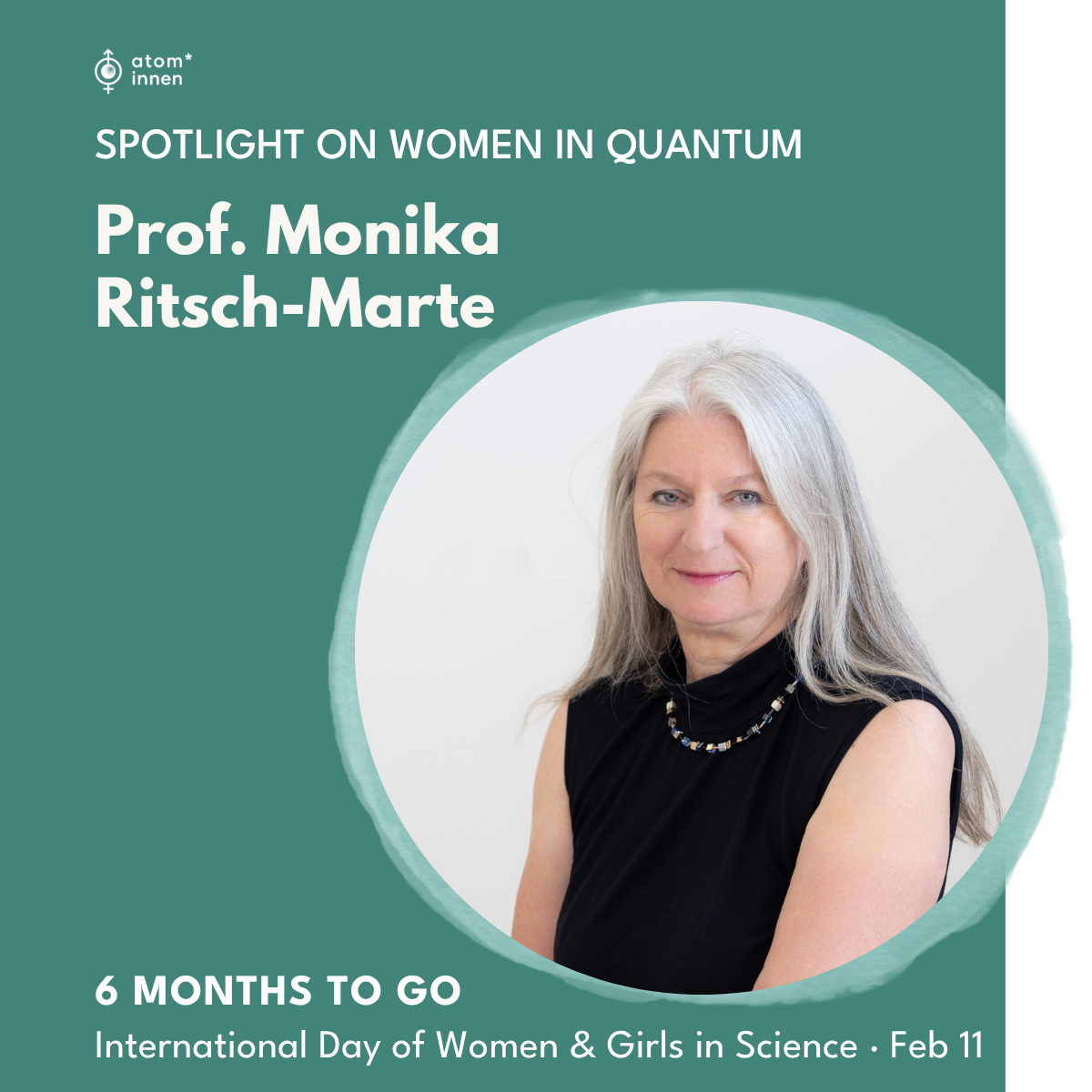
Professor Monika Ritsch-Marte, Director of the Institute of Biomedical Physics at the Medical University of Innsbruck, is one of the most distinguished physicists working in Austria today. Very recently, she was awarded her second ERC Advanced Grant, worth €2.5 million, to conduct research into acousto-fluidic tools for organoid studies.
Ritsch-Marte received her M.Sc. in Physics from the University of Innsbruck in 1984 and her PhD in Quantum Optics from the University of Waikato in New Zealand in 1988. Her doctoral research focused on generating and applying laser light with quantum mechanical properties. Following postdoctoral positions in Boulder Colorado, Milan and Helsinki, she was appointed Chair of Biomedical Physics in Innsbruck in 1998.
Monika Ritsch-Marte is also a member of the Austrian Academy of Sciences and the Leopoldina and has received numerous research grants and awards, including two ERC Advanced Grants and the Boltzmann Award of the Austrian Physical Society. In September 2023, she became the first physicist working in Austria to receive the prestigious Emmy Noether Award from the European Physical Society. In 2007, she became the first woman to be elected President of the Austrian Physical Society, and she has been a tireless advocate for women in physics ever since. In this interview, she discusses her research and her many experiences as a woman in physics.
Looking back: Could you tell us what originally drew you to physics? Was there a moment when you knew it was the right path for you?
Before answering your first question, I would like to thank you for inviting me here. I think it's very important that the next generation of female physicists is taking up the issue of equity in physics. Things were very different a few decades ago – engaging with these issues could cost you your job, and it did cost me mine. Things are improving, but there's still a lot of work to be done. So, I would like to thank atom*innen for keeping these issues up and for furthering the cause.
Back to your question: From an early age, I was fascinated by nature, and I always knew that I wanted to become a natural scientist. I'm still a passionate hobby botanist and ornithologist today. However, the real turning point came at school, when I had an excellent teacher of mathematics and physics – that's when I fell in love with mathematics. I realized that if you really want to understand nature, you need mathematics. Essentially, the combination of nature and mathematics is physics. However, I also had my doubts: at my school physics wasn’t seen as a something a girl could or should do. I was hesitant too, but at some point (actually at a university open day), I decided to give it a try. It was difficult at first. People tried to discourage me – professors and even other students were sometimes unwelcoming and cruel. But I found my way, and I never regretted it.
Your research focuses on using optical and also acoustic forces to trap and manipulate particles, work that was supported in part by one of the first ERC Advanced Grants ever awarded. For those less familiar: could you explain what it means to "trap" a particle with light or sound, and why that is so powerful for biomedical research?
When I moved from theoretical quantum optics to applied biomedical optics, using a focused laser beam as an optical trap, or optical tweezers, was a natural starting point. For many years, we used light to trap, hold and stretch or move things without actually touching them. For instance, one can examine DNA strands or determine the elasticity of a cell or organelle by measuring the forces involved with great precision. Over time, we wanted to trap larger objects and did a lot of advanced imaging deeper into tissue, which was challenging. The problem with this is that if you want to catch and hold very large biomedical samples, such as a three-day-old zebrafish embryo, you would need so much laser focus power that you would simply burn the sample. About ten years ago, therefore, we started experimenting with acoustic forces, using pressure patterns alongside or instead of light. This combination proved highly successful: acoustic forces counteract gravity and hold the sample in place while optical forces allow for much finer manipulation.
Recently, some of our collaborators were having difficulty studying certain samples that are challenging to image optically. These samples absorb and scatter a lot of light, meaning that only one side can be seen. Imagine trying to look through a zebrafish's head: You would like to create a reconstruction, but the light is attenuated so much that you simply can't see the other side. However, with our acoustic traps, we can rotate the sample itself, turning it as you would in a CT scan, to see all sides. This allows us to reconstruct the 3D refractive index distribution of the object in a contact-free manner.
Now, with an X-ray scan, you always know where the source is. But with acoustic rotation, the movement is somewhat unpredictable, there is always some tilt or shift that depends on the unknown object itself. Therefore, we had to develop a new algorithm that can also reconstruct the exact position of the object. Otherwise, it would be a bit like a patient moving during a scan which gives a poor image. We solved this problem in collaboration with colleagues from the Medical University of Vienna, who handled the imaging while we contributed the acoustics and reconstruction software. A perfect match for us!
So, is this a technique that can now be used in research?
We certainly hope that many people will start using it, especially for organoids – tiny, organ-like structures grown from stem cells in a Petri dish that mimic real organs such as the stomach, lungs, muscles or even the brain. They are notoriously difficult to image. However, our technique is suited to this, so this is a great success for us. We are now also applying it to cancer spheroids – lab-grown tumor models that are equally difficult to image optically.
I came across your 1996 essay 'Dear Sir: Anmerkungen zum Physikerinnen-Dasein', which you co-authored with Prof. Claudia Draxl. In it, you describe what it is like to be a woman in physics in the 1990s, for example, always feeling slightly like an outsider, being seen as an 'exotic' or not being taken seriously as a female physicist. Before we go into detail: What kind of reaction has the text received from the public?
We received lots of anonymous threats. Mind you: this was before digitization and social media, so it meant written letters, some of which were from neo-Nazi circles. It even came to a point that the police was investigating. It's interesting that people still went to the trouble of sending written threats in an era when that required sitting down and writing a letter rather than dropping a quick anonymous comment online. I never regretted publishing that paper, as it clearly hit a nerve. People still read it and it is still being cited. And all of these experiences came from our daily lives, we did not exaggerate anything.
Did you find it easy to recognize that gender had an impact on your career?
Initially, I would say that I was a bit naïve, but it hit me twice: First, I was constantly compared to my husband, who worked in the same field. Then, I was compared to my brother, who was five years younger than me and had also started studying theoretical physics. They would offer him jobs, but not me. It was only the second time that I really understood what was going on. Having this experience twice made me think. I often hear from older female colleagues that they initially did not realize it, but in hindsight, once you look at the facts, you see some patterns emerging, not just in the statistics, but in your own life too, interestingly.
As a woman in physics, on the one hand, you’re simply the exception in the room, the one who’s different – you’re always being watched and remembered, for better or worse. If your presentation is great, this will help you; if it’s bad, it can ruin you. The second aspect is the broader societal difference in how women and men are perceived, quite apart from the field of science – questions about family and what a woman “should” do. As a female physicist, you experience both effects at the same time. You’re still viewed as someone who is a bit exotic, and then there are all those societal expectations and stereotypes.
If you compare the situation of women at the start of your career with the situation now, what differences do you notice?
Compared with the 1980s and 1990s, people now certainly appreciate that women can be good scientists. This was genuinely in doubt when I started studying physics in the 1980s. People wouldn't take you seriously – they wouldn't discuss things with you, and would instead ask you to make the coffee. "Are you the secretary?" was the standard question for any new woman in the room. I was once thrown out of a lecture hall without anyone asking me who I was or what I was doing there. Also, at conferences, the ratio of male to female attendees was 100:1, which is extremely unbalanced. Such things have clearly changed, but we still have some way to go to achieve full equality. For instance, we need to address the additional burden that many women bear because they perform more care work than their partners. This is often not even discussed, but it's very common. I was lucky in that respect, as my husband supported me in everything. We have two daughters and I could always rely on him. But I've seen colleagues who did not have that kind of support, and I still notice this kind of difference.
Are there other areas where you notice a difference?
In my opinion, we need to take a closer look at the issue of recognition. When do women’s names tend to come up? For instance, women are often the first people suggested for prestigious committees that involve a lot of work. However, when it comes to awarding someone for their great scientific work, far fewer women spring to mind. Although I am personally honored to have received many awards myself, I still feel that there is a clear discrepancy: We're asked to judge the highest possible recognitions, yet as a peer group, we're never considered for it ourselves. I find this strange, and it is also the subject of current research. This is why I advise my younger female colleagues to be careful about automatically agreeing to be part of these prestigious committees.
I've also noticed that whenever I nominate a female colleague and all the nominators and nominees are female, my success rate is zero. I did this so many times that, at some point, I stopped as it felt like a waste of time.
Do female colleagues need to be cautious about committee or also outreach work in general?
I think we need to raise awareness of this issue. I have done this kind of work all my life and always enjoyed it, but it takes time and energy away from other things. It's certainly valuable – it strengthens you and develops you as a person in many positive ways. But if you do too much of it, it can actually hinder your career progression.
Let me give you an example of what this kind of engagement can look like. At the IUPAP Women in Physics Conference in Paris in 2001, for example, participants from 60 countries gave talks and presented reports or posters on the status of women in physics. We decided to discuss the situation of women in physics in Austria by comparing the lives of two Austrian physicists: Lise Meitner and Marietta Blau. Back then, hardly anyone knew who Marietta Blau was. We asked ourselves why one of them became famous while the other did not, despite both having been nominated for the Nobel Prize multiple times. The Austrian delegation published a small note on this topic, which was fun but also devoured some time and energy. So, my advice to young women here is: if you find yourself drawn to this kind of work, it will open your eyes to many things. It broadens your mind and it introduces you to areas you wouldn't normally explore. It can be very rewarding. However, it does take up some of your valuable time, so you should be aware of that.
Did that international perspective change how you saw the situation in Austria or Europe?
It certainly did. I'll never forget the speech that my colleague from Cairo gave at that conference. She said, 'Most importantly, if you want a career in physics, you need to find the right husband or partner.' Then an older colleague from Pakistan stood up and said, 'You're right – if you're even allowed to marry that one.' That stayed with me. We talk about our problems in the Western world, but there are many worrying situations elsewhere, and a lot of backlash is happening right now, too. In some countries, you're not even allowed to choose your own family. Although we have problems here, comparatively, we're still operating in a very protected space. I think it's important to keep that in mind.
What kind of advice would you give to young women today who are interested in a scientific career in physics?
If you love physics, go for it! If you're feeling a little sceptical, that's fine: Women tend to be very self-critical and doubt their work and themselves more than men usually do. This can seem like a disadvantage, but if you think about it: It's a valuable scientific trait. You need people who are sceptical and not easily convinced to do good science. It may be a disadvantage if you're unaware of how society reacts to it. Once you are aware of it, it becomes an asset – a good scientist should doubt their own results, this is part of what makes science work.
Another piece of advice I would offer is to avoid comparing yourself too much with others, whether in terms of h-index or number of papers published – that's not what matters. Find a question that matters to you and work out how to solve it. Have passion for it and you will be successful in the end.
We want to thank Prof. Monika-Ritsch Marte very much for her openness and for sharing her thoughts and experiences with the atom*innen community.
If you want to learn more about Monika-Ritsch Marte, you can check:
- Personal Homepage
- Research
- Newspaper article about her latest ERC Advanced Grant [in German]: ORF Tirol
- Monika-Ritsch Marte on Wikipedia
- Women in Physics in Austria publication: https://doi.org/10.1063/1.1505295
- 'Dear Sir: Anmerkungen zum Physikerinnen-Dasein' essay: onlinelibrary.wiley.com/doi/pdf/10.1002/phbl.19960520112
Author: Karoline Irschara
published on 2026-07-11