
Community
Privacy settings may have prevented some items from showing.
Please update your search criteria and try again

When: Tuesday, 27 October 2026, 12:00–13:30
Where: IQOQI Library, ICT Building, 3rd floor
Costs are covered by IQOQI.
Places are limited. Please register by emailing karoline.irschara@oeaw.ac.at and indicate any dietary requirements.

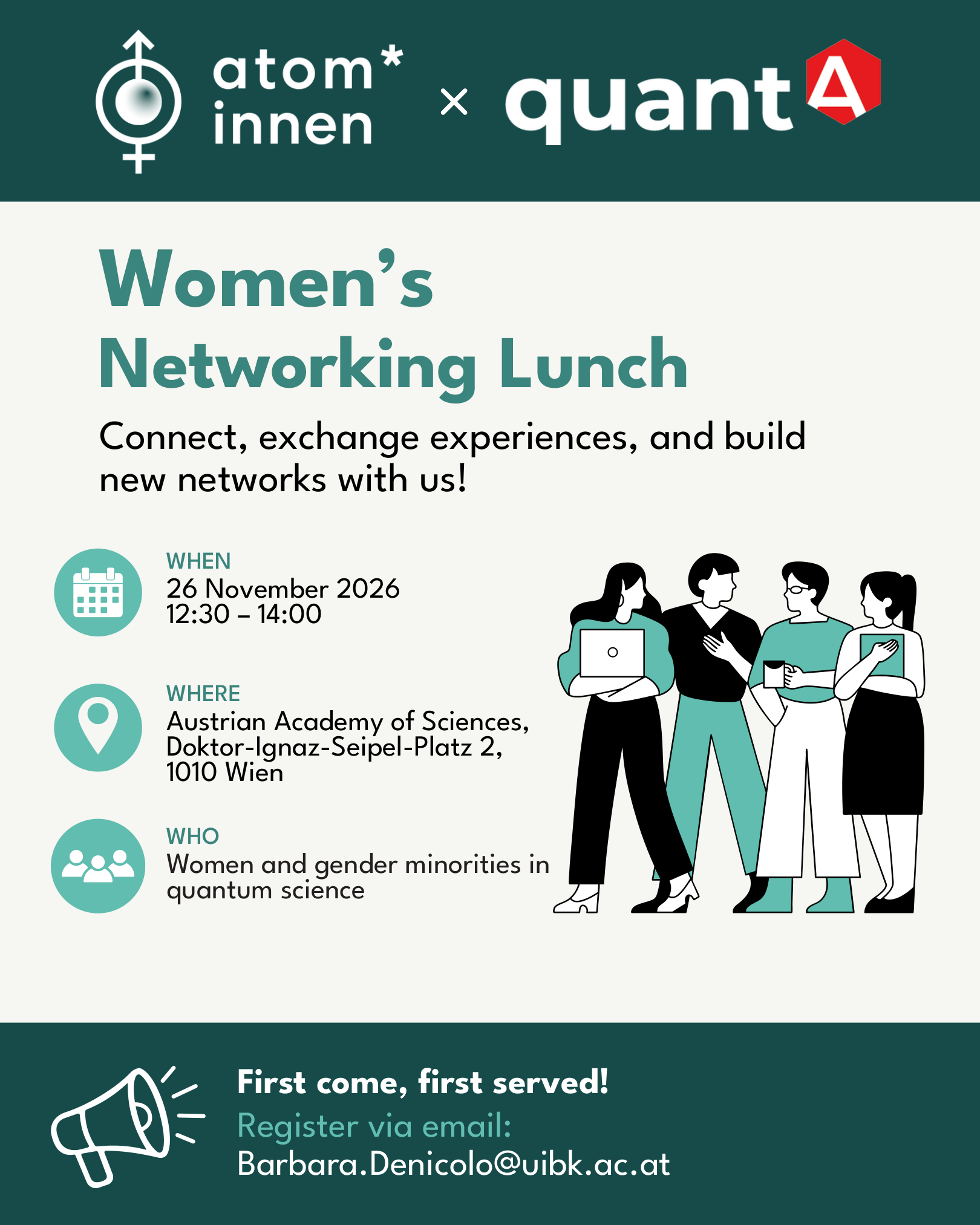
26 November 2026 | 12:30–14:00
Aula, Austrian Academy of Sciences
Doktor-Ignaz-Seipel-Platz 2, 1010 Vienna
Join us for a special atom*innen × quantA Women’s Networking Lunch bringing together women and gender minorities from across the quantum science community.
The lunch offers an informal space to connect, exchange experiences, and build new networks across institutions and career stages. We particularly want to create opportunities for early-career researchers to interact with more experienced colleagues and exchange perspectives on careers, research, and life in quantum science.
To make it easy to meet new people, we will provide conversation starters and opportunities to connect with others who share your interests or experiences.
The event is jointly organised by the Cluster of Excellence quantA and atom*innen.
Come along, meet new people, exchange ideas, and be part of a growing community of women in quantum science.
Register via email:
Barbara.Denicolo@uibk.ac.at
First come, first served!

This session on equality in physics takes place as part of the OePG-CMD Joint Meeting 2026 — the 75th Annual Meeting of the Austrian Physical Society and the 32nd Meeting of the Condensed Matter Division of the European Physical Society (EPS). The conference will be held 20–25 September 2026 at the University of Graz, Graz Center of Physics, Austria.
atom*innen at this session
atom*innen will be attending the meeting for networking and community building. We are also pleased to contribute a talk at 17:00: Physics Needs Everyone: The atom*innen Platform as a Tool for Equity and Change, presented by Karoline Irschara. Come by, say hello, and join the discussion!
Session Programme
Chair: Andrea Navarro-Quezada
| 16:00 | Session opens |
| 16:30 |
Thomas Berghofer, GENERA Network GENERA Network: 10 Years of Exchange and Activities on Gender Equality in Physics in Europe |
| 17:00 |
Karoline Irschara, atom*innen Physics Needs Everyone: The atom*innen Platform as a Tool for Equity and Change |
| 17:30 |
Ira Morawetz, TU Vienna (Berta Karlik Awardee 2025) Progress Towards Th-229 Nuclear Clock Development |

The 9th International Conference on Women in Physics (ICWIP2027), organised under the International Union of Pure and Applied Physics (IUPAP) Working Group 5, will take place at the National University of Singapore (NUS), 7–11 June 2027. It is the 9th in a series of triennial conferences held since 2002, bringing together practitioners from around the world to address both physics topics and the barriers to equity and inclusion within the field. ICWIP2027 is hosted by the NUS Department of Physics and the Centre for Quantum Technologies (CQT), Singapore. Written contributions will be refereed and published in the American Institute of Physics (AIP) Conference Proceedings series.
Programme Highlights
- Keynote lectures by eminent women scholars
- Parallel physics sessions of 3-minute oral poster sparklers
- Plenary session of 2-minute poster sparklers presenting country reviews on gender equity
- Interactive workshops on barriers to gender equity and recommendations for change
- Plenary concluding session presenting the conference recommendations
- Regional meetings and networking opportunities
- ...and more!
How participation works
Unlike an open-registration conference, ICWIP participation runs through country teams. Each country team designates up to five members to attend in person. If you'd like to participate, please contact your country's Team Leader. The official list of Team Leaders will be published on the conference website.
More information: FAQs | Organising Committees

In 2026, the Deutsche Physikerinnentagung will be hosted by the Rheinland-Pfälzische Technische Universität (RPTU) Kaiserslautern-Landau. The scientific focus is on solid-state, bio-, and spin physics, as well as photonics and quantum technologies — alongside contributions spanning physics from elementary particles to cosmology.
The scientific programme is complemented by careers-in-industry events, soft-skills workshops, and networking opportunities with representatives from industry and research. The conference is supported by the Working Group on Equal Opportunities (AKC) of the Deutsche Physikalische Gesellschaft (DPG).
atom*innen will be on site throughout the conference for networking — come say hello! We're also taking part in a panel discussion:
Tuesday, 29 September, 1:30–2:30 p.m.
“Gender Equality Measures: What Works? Best Practices.”
- • Keynote · Prof. Dr. Karin Jacobs, Saarland University
- • Public Plenary · Prof. Dr. Sibylle Günter, MPI for Plasma Physics Greifswald
- • Keynote · Prof. Dr. Monika Ritsch-Marte, Medical University of Innsbruck
- • Keynote · Dr. Maria Azhar, University of Duisburg-Essen (Hertha-Sponer-Preisträgerin 2026)
- • Dr. Andrea Bergschneider, University of Bonn
- • Prof. Dr. Maria Dienerowitz, University of Applied Sciences Jena
- • Dr. Zlata Fedorova, Friedrich Schiller University Jena
- • Prof. Dr. Katharina J. Franke, Freie Universität Berlin
- • Prof. Dr. Anja Metelmann, Karlsruhe Institute of Technology
- • Prof. Dr. Giovanna Morigi, Saarland University
- • Jun.-Prof. Dr. Iris Niehues, University of Münster
- • Prof. Dr. Silke Bühler Paschen, Vienna University of Technology
- • Dr. Pauline Rovillain, CNRS Paris
- • Prof. Dr. Julia Stähler, Humboldt-Universität zu Berlin
- • Prof. Dr. Dr. hc. Viola Vogel, ETH Zurich
- • Dr. Gesa Welker, Delft University of Technology
- • Jun.-Prof. Dr. Angela Wittmann, Johannes Gutenberg University Mainz
A dedicated GirlsGoPhysics Tag runs alongside the main conference, with its own programme, workshops, and registration.
Questions? Contact dpt2026@rptu.de

We have a wonderful opportunity coming up: Prof. Urbasi Sinha from the Raman Research Institute in Bangalore will be visiting UIBK and IQOQI — and we'd love to use this occasion to bring together women and gender minorities in quantum for an informal lunch. With quite a few new faces around at the moment, it's a great chance to get to know each other and connect in a relaxed setting 😊
| 📅 When | Friday, 12 June 2026 | 12:00 – 13:30 |
| 📍 Where | IQOQI Library, ICT-Building, 3rd floor |
👉 Please register by sending an email to karoline.irschara@uibk.ac.at

It Takes a Quantum Village
WIQD Symposium 2026 – Celebrate the quantum community in Utrecht.
Register now →This year's WIQD Annual Symposium is all about people. The theme It Takes a Quantum Village is a reminder that quantum isn't shaped by a few big names — it's built by all of us.
Building on past editions with over 100 participants, the format is refreshed in 2026: alongside workshops and networking, WIQD is introducing the brand-new WIQD Awards Ceremony.
What to expect
- Opening session — celebrating five years of the flagship event
- Interactive workshops
- WIQD Awards ceremony
- Networking & borrel
The WIQD Awards 2026
Three categories recognising people who help make the quantum ecosystem more inclusive and supportive:
For individuals or groups who contribute beyond their formal role — through mentorship, advocacy, or initiatives supporting underrepresented groups.
For leaders in academia, industry, or policy who actively create inclusive and socially safe environments.
For outstanding Bachelor's, Master's, or PhD students showing strong promise and inclusive values.
The event is open to everyone interested in quantum and community — whether you're a student, researcher, professional, or simply curious. No expert knowledge needed.
Come join us in Utrecht and be part of our quantum village ✨

Why Diversity Makes Better Physics
Keynote at the DPG Spring Meeting in Mainz
Karoline Irschara, Gender Officer at atom*innen, together with Ulrike Böhm (ZEISS Group), will deliver a keynote address at the DPG Spring Meeting in Mainz.
Their presentation, titled “Why Diversity Makes Better Physics”, explores the benefits of diversity in Physics.
About the Talk
Despite clear advantages, significant gender imbalances persist in physics. Although the number of women studying physics in Central Europe has steadily increased, they remain underrepresented at senior levels. In Germany, for example, women currently hold only 12% of physics professorships — far below the threshold required to reach a critical mass.
The keynote will:
- Present recent data on gender representation in physics
- Examine structural and cultural factors contributing to disparities
- Discuss why diversity is essential for scientific excellence and innovation
- Highlight best practices from academia and industry
- Introduce atom*innen, the interactive platform connecting women and gender minorities in quantum physics
The presentation concludes with actionable measures aimed at strengthening inclusion and promoting equal opportunities within the physics community.
Networking Event
Following the keynote, participants are warmly invited to join an in-person networking event with refreshments.
If you are attending the meeting, we would be delighted if you stop by and connect with us.
The keynote and networking event are co-organized by jDPG and AKC, working groups within the German Physical Society (DPG). Special thanks to Sarah Embacher and Sabine Rockenstein for facilitating this collaboration.

History of Science at Lofty Heights
History was made in an inconspicuous construction hut high above Innsbruck: the Victor Franz Hess measuring station, founded in 1931 by Nobel Prize winner Victor Franz Hess, was the world's first high-altitude laboratory for researching cosmic radiation. As early as 1912, Hess had detected previously unknown radiation during a spectacular balloon flight at an altitude of over 5000 m – it increased with altitude and therefore had to originate from space. Even today, cosmic radiation remains one of the great mysteries of physics – and is being researched worldwide. The historic measuring station was designated a “Historic Site” by the European Physical Society in 2022.
Marietta Blau – A Forgotten Pioneer
In 1937, another scientific sensation occurred at this location: Marietta Blau and her assistant Hertha Wambacher observed for the first time how a high-energy particle smashed an atomic nucleus – documented on special photographic plates. But after Austria's annexation by the Nazi regime, Blau, who was persecuted as a Jew, had to flee into exile. Her research was continued by her assistant without proper recognition. Blau is representative of many women whose scientific achievements have been rendered invisible – due to political circumstances, discrimination, or deliberate exclusion.
Ultra | Memory Meets the Present
The Ultra project sends a powerful message about visibility and remembrance. It addresses the structural barriers that women in science have faced and continue to face, focusing on social issues such as equality, recognition, and participation. An accompanying lecture with a panel discussion featuring a physicist from the University of Innsbruck establishes a connection to current research and invites dialogue on gender issues in science.
Art Meets Research: A Sound Laboratory of the Cosmos
In Ultra, artist Tim Otto Roth explores the connection between art and science with an immersive light and sound installation that brings Marietta Blau's scientific legacy to life. Roth's works operate at the intersection of natural science and aesthetic experience. His artistic practice includes collaborations with institutions such as the Max Planck Society, NASA, the IceCube Observatory, and the European Southern Observatory. The focus is on the sound laboratory [aiskju:b], specially adapted for Innsbruck, consisting of 444 illuminated loudspeakers fed with data from the IceCube Neutrino Observatory. What is measured there in Antarctica becomes a sound and light score in Ultra, allowing visitors to experience cosmic processes with their senses. The title Ultra not only refers to the old name for cosmic radiation, “ultra radiation,” but also invites us to engage with phenomena that are everywhere but remain hidden from our senses.
Exhibition Program
The exhibition is generally open from September 5 to October 24, Fridays and Sundays from 4:00 p.m. to 7:00 p.m. additional to the following events:
September 19 | 7 p.m.
Lecture by Anita Reimer (professor of astrophysics) on the origin of cosmic rays, followed by a panel discussion with Anita Reimer, Brigitte Mazohl, Carmen Brucic, and Karoline Irschara (from atom*innen).
September 27 | 1 p.m.
Tour of the Victor Franz Hess Research Station at Hafelekar with an introduction by Emerich Kneringer. Meeting point: Hafelekar Research Station. Registration is required.
October 24 | 7 p.m.
Closing event for the KG 17 project ULTRA memoria cosmica.

generate highly entangled states of matter. Besides the promising advancements for quantum simulation and computing, the recent achievements in cavity-enabled control of molecular reactions and the manipulation of electronic properties in strongly correlated electronic materials have opened two new and rapidly evolving research directions.
This interdisciplinary workshop brings together leading experts and early-career researchers working on different aspects of cavity control, and provides an environment to share ideas, find synergies and establish new collaborations. Topics will include cavity field fluctuations, cavity polaritonics, cavity control of phase transitions in ultracold atoms and in materials, entanglement for quantum networks, as well as applications in quantum sensing, quantum computing, and quantum simulation.
Invited speakers:
Benea-ChelmusIleana-Christina, EPF Lausanne
Bloch Jacqueline, Université Paris, Saclay
Ciuti Cristiano, University Paris Cite
Fausti Daniele. FAU Erlangen-Nürnberg
Imamoglu Atac, ETH Zürich
Kollath Corinna, Universität Bonn
Lesanovski Igor Universität Tübingen
Lindel Frieder, ETH Zürich
NorthupTracy, Universität Innsbruck
Piazza Francesco, Universität Augsburg
Simon Jonathan, Stanford University
Rey Ana-Maria, University of Colorado
Rempe Gerhard, Max-Planck Institut für Quantenoptik, München
Stamper-Kurn Dan, UC Berkeley
Sentef Michael, Universität Bremen
Warburton Richard, Universität Basel
Weichman Marissa, Princeton University

We are excited to host the Long-Range Interactions Workshop 2025 in Stuttgart from 22 – 24 September 2025 at Altes Schloss, Stuttgart.
Invited Speakers
Hadiseh Alaeian (Purdue University)
Annabelle Bohrdt (University of Regensburg)
Lawrence Cheuk (Princeton University)
Lauriane Chomaz (University of Heidelberg)
Fabio Cinti (University of Florence)
Francois Dubin (Université Côte d’Azur)
Igor Ferrier-Barbut (Institute d’Optique)
Rosario Gonzalez-Ferez (Universidad de Granada)
Tijs Karman (Radboud University)
Athanasios Laliotis (Université Sorbonne Paris Nord)
Giovanni Modugno (Università di Firenze)
Beatriz Olmos Sanchez (University of Tübingen)
Ronen Rapaport (Hebrew University)
Stephanie Reimann (Lund University)
Clément Sayrin (Laboratoire Kastler Brossel)
Stefan Scheel (University of Rostock)
Mike Tarbutt (Imperial College London)
Arina Tashchilina (University of Alberta)
Susanne Yelin (Harvard University)
Organizers
Francesca Ferlaino, University of Innsbruck
Antoine Browaeys, CNRS, Institut d'Optique
Robert Löw, University of Stuttgart

Confirmed speakers
Kimberly Modic (IST Austria)
Beatrix Hiesmayr (University of Vienna)
Anna Spindelberger (Infineon)
Rachel Grange (ETH Zürich)

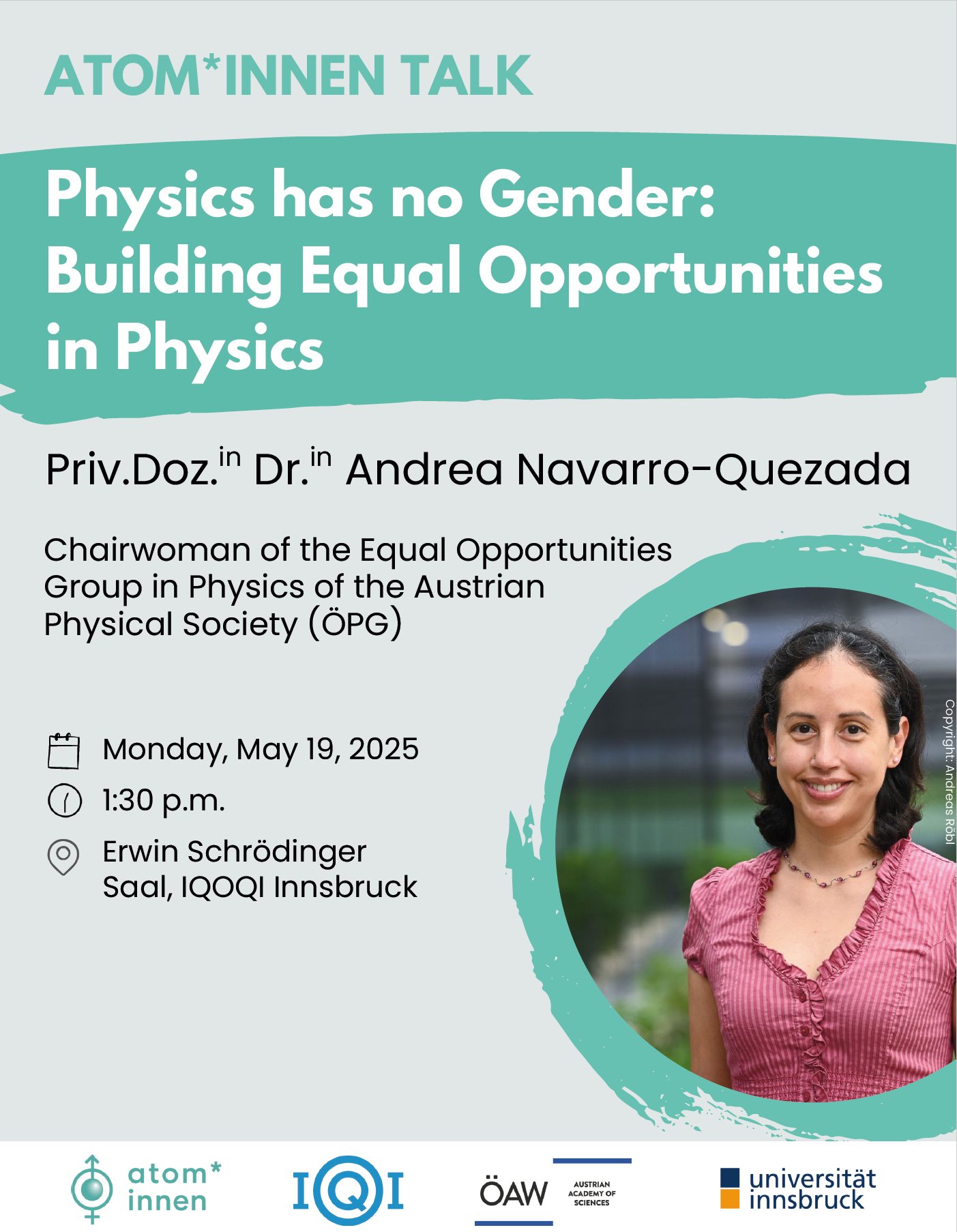
📅 Monday, May 19, 2025
🕜 2:30 p.m.
📍 Erwin Schrödinger Saal, IQOQI Innsbruck
We are excited to welcome Priv.-Doz.in Dr.in Andrea Navarro-Quezada as our speaker in our next ATOM*INNEN TALK. In her talk, “Physics has no gender: Building Equal Opportunities in Physics,” she will explore gender disparities in Austrian physics academia, present key data and insights, and discuss the role of initiatives like the Equal Opportunities in Physics Group of the Austrian Physical Society in promoting lasting change.
Although the number of female physics students in Austria has increased slightly over the last 25 years, only 13% of physics professors are women. Discrimination in physics is still present and controversial for some. In this talk, Andrea Navarro-Quezada will present some facts and figures from Austrian universities, discuss possible causes, and highlight the importance of initiatives like the Equal Opportunities in Physics Group of the Austrian Physical Society in achieving equal opportunities for all.
About the Speaker:
Andrea Navarro-Quezada is a Funding Consultant for the Research Support Office of the Medical Faculty of the Johannes Kepler University Linz and Chairwoman of the Equal Opportunities Group in Physics of the Austrian Physical Society. She was awarded the prestigious Elise Richter Fellowship and received her habilitation in experimental physics in 2021. Andrea Navarro-Quezada also writes the physics blog "Die Physiker:innen" for Der Standard.
☕ Join us after the talk for coffee, pastries, and informal discussion.
We look forward to seeing you there!

With the quantA & atom*innen lunch, we want to provide a dedicated networking space for women and gender minorities in quantum science.
The lunch takes place as part of the 4th quantA Workshop (held from April 24–25, 2025 at JKU Linz, MedCampus)
Lunch Details:
📍 Börserie, 70 Schillerstraße, 4020 Linz
🕚 April 24, 11:00 a.m.–1:00 p.m.
Come connect, share ideas, and build community! 💬✨

📍 Where?
Carmen de la Victoria, Cuesta del Chapiz, 9, 18010, Granada, Spain 🇪🇸
🗓 When?
1sth to 5th September 2025
Confirmed Invited Speakers:
🔹 Federico Carollo (Coventry University)
🔹 Lauriane Chomaz (University of Heidelberg)
🔹 Anja Metelmann (Karlsruhe Institute of Technology/University of Strasbourg)
🔹 Tilman Pfau (University of Stuttgart)
Guest speakers:
🔹 Angela Capel Cuevas (University of Cambridge)
🔹 Juan P. Garrahan (University of Nottingham)
🔹 Michalis Skotiniotis (University of Granada).
Registration
Places on the summer school are limited so early registration is recommended. Applications will be considered by a selection panel to achieve an appropriate balance of attendees. The registration is open until May 31st: https://granada-summer-school.com/
✉️ bec2025@phys.ethz.ch
Header (c) Granada Summer School https://granada-summer-school.com/

📍 Where?
Hotel Eden Roc, Sant Feliu de Guíxols, Spain 🇪🇸
🗓 When?
Saturday, September 6th (day of arrival) – Friday, September 12th, 2025 (day of departure)
The conference will cover several topics including:
🔹 Physics of bosonic and fermionic quantum gases
🔹 Quantum simulation with single-atom resolution
🔹 Quantum computation with ultracold neutral atoms
🔹 Synthetic gauge fields & topology
🔹 Quantum magnetism
🔹 Long-range interactions & Rydberg systems
🔹 Open quantum systems
✉️ bec2025@phys.ethz.ch
Header (c) BEC 2025 from https://indico.phys.ethz.ch/event/143/

📅 July 13 - August 3, 2025
📍 Aspen Physics Center
Organizers:
Tijs Karman, Radboud University
*Tim Langen, Vienna University of Technology
Sebastian Will, Columbia University
Tanya Zelevinsky, Columbia University
*represents the organizer in charge of promoting diversity
Ultracold molecules are opening new fields of exploration: Quantum simulation with dipolar molecules is within reach with the recent advent of quantum degenerate gases. Tabletop precision measurements with molecules can complement collider experiments at the energy frontier, provide the most stringent tests of time-reversal symmetry, and enable tests of the Standard Model. Last but not least, cold molecules help answer fundamental questions about molecular collisions and chemical reactions, and offer new ways for their control. This workshop will foster interactions between experiment and theory, focusing on identifying novel scientific opportunities in three interlinked topics: quantum many-body physics, precision measurements, and cold collisions and chemistry.
👉 Apply here (the Deadline is January 31, 2025): https://aspenphys.org/summer-workshops/#event5562
Header by Aspenphysics - Own work, CC BY-SA 4.0, https://commons.wikimedia.org/w/index.php?curid=133953656

To mark next year’s International Day of Women and Girls in Science, the Diplomatic Missions of Canada, France, Italy, Sweden, Switzerland, the Netherlands, and the United Kingdom – in partnership with the Austrian Academy of Sciences (OeAW) – invite you to an expert panel discussion on women breaking frontiers in science. High-level panellists will offer a global perspective on bridging the gender data gap and will discuss how AI-driven solutions should be developed to ensure health equity for everyone. Join us to explore the future of inclusive healthcare and biomedical research with a gender perspective on technology development, data quality and policy frameworks.
- When: Tuesday, 11th of February 2025, 10:00am-13:30pm
- Where: Johannessaal, Austrian Academy of Sciences, Dr. Ignaz Seipel-Platz 2, 1010 Vienna
The event will be held in English and will be followed by an opportunity for networking over a buffet lunch.
Registrations via https://www.eventbrite.com/e/women-in-science-breaking-frontiers-a-data-perspective-tickets-1106353686659?aff=oddtdtcreator
Picture: (c) ÖAW