

Prof. Monika Aidelsburger on building controllable quantum systems and why now is a great time to work in quantum science
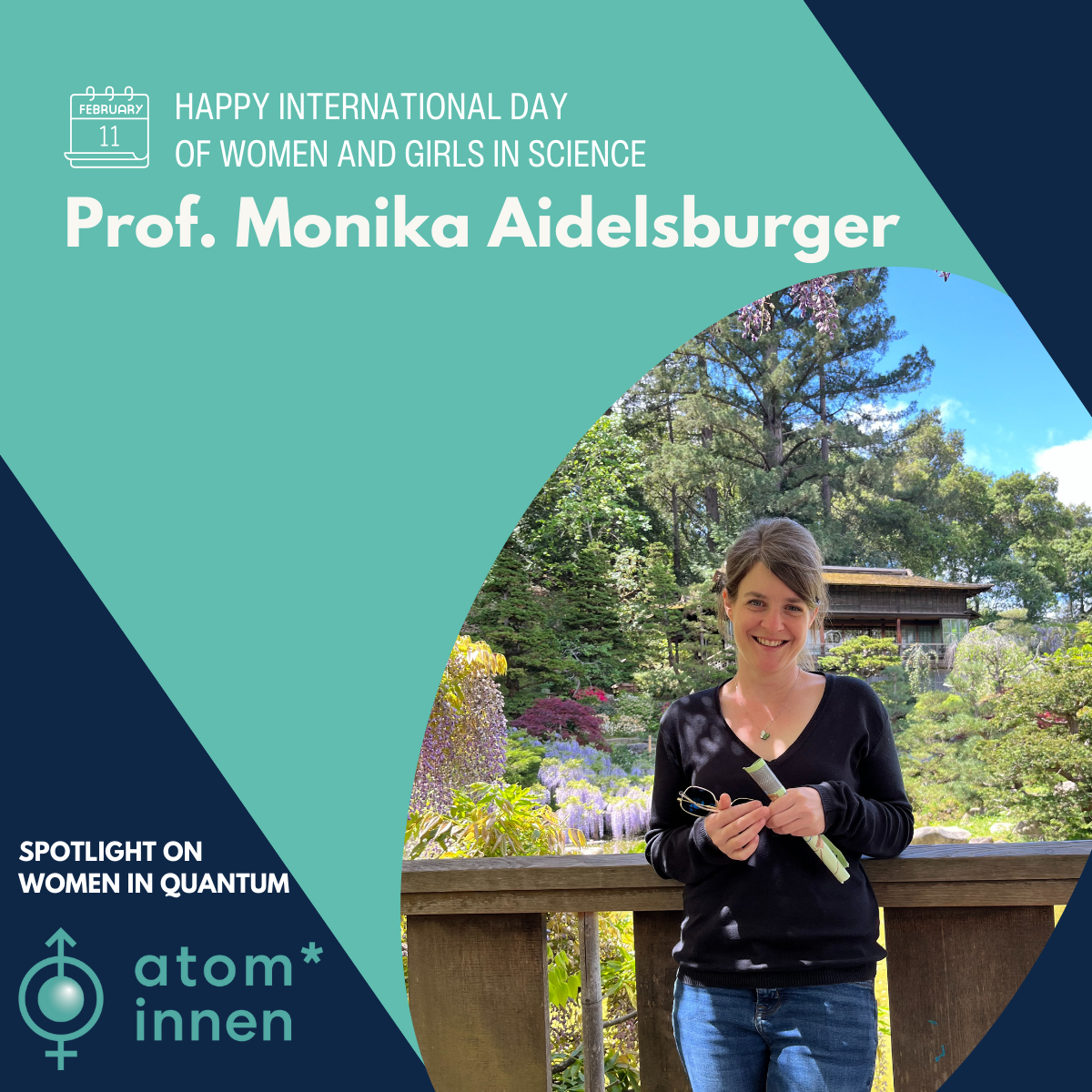
Monika Aidelsburger is a professor of experimental quantum physics at Ludwig Maximilian University of Munich (LMU), and leads a W2 research group (Engineered Quantum Systems) at the Max Planck Institute of Quantum Optics.
She received her PhD from LMU Munich in 2015, working under the supervision of Immanuel Bloch. Her research focused on ultracold atoms in optical lattices. From 2016 to 2017, she was a Marie Curie postdoctoral fellow at the Collège de France, where she worked alongside Jean Dalibard on uniform Bose gas. In 2017, she came back to Munich as a group leader. In 2019, she established her own group and was promoted to professor.
Her research centres on quantum simulation, using ultracold atoms in optical lattices to study topological phases and lattice gauge theories. She has received numerous prestigious awards, including an ERC Starting Grant, the Alfried Krupp Prize, and the Klung Wilhelmy Science Award. In 2022, she was elected a member of acatech, the German Academy of Science and Engineering.
We met Prof. Monika Aidelsburger in November 2025 at IQOQI in Innsbruck, where she gave a lecture on computational quantum simulation with neutral atoms. We would like to thank her very much for taking the time to share her perspective with atom*innen.
Prof. Aidelsburger, have you always been interested in physics?
For me, choosing to study physics wasn't an obvious decision from the outset. Coming from a non-academic background, I wasn't necessarily aware of the subjects available to study. At school, I studied Latin and French. I could see myself pursuing a career in languages, culture or art. However, towards the end of school, my priorities changed. I still liked languages, but writing essays began to feel somewhat arbitrary – it was okay, but I felt that there was something more interesting. I found the logical structures of mathematics and physics increasingly attractive. When you calculate something, the answer is either right or wrong - there's much less room for interpretation. That clarity was fascinating. I was good at math, but math alone felt too abstract. Physics was close enough, and I kept hearing that physicists could do many different things. I also heard that physics was really challenging, and that motivated me - so I gave it a try and that's how I ended up in physics.
What has attracted you to the field of quantum physics?
At university, I became interested in theoretical physics and quantum mechanics. I found it both incredibly exciting yet also very abstract – nothing you encounter in everyday life. Fortunately, during my master's and Ph.D. programs, experimental techniques had advanced to the point where quantum mechanics could be observed in the lab. You could build experiments in which particles behaved exactly according to quantum rules, visibly in the lab. Seeing these abstract concepts materialize was fascinating. From that moment on, I knew that I wanted to pursue this fascination. Also, quantum experiments are incredibly diverse. I enjoy that aspect the most: the field is very broad and constantly evolving. It is part of my job to learn new things, and I think that's just great!
Your enthusiasm is contagious! How important is it to pass on this kind of excitements about science to others?
Of course, all of this eventually becomes routine when it's part of your everyday life. That’s why I really like to take a step back and reflect on what we are actually doing in our labs. It's incredible that we arrange individual atoms or ions in precise patterns, build artificial lattices and manipulate them to observe quantum phenomena. What we're doing here is crazy.
Outreach is certainly very important. Recently, I was asked if I would like to participate in a children's TV programme about atoms. At first, I thought it would be difficult to create something worthwhile in such a short time. However, I think you can explain to children that everything is made of atoms, how small they are and that you can build things out of them, just like Lego. There are now great games and apps that can make quantum physics fascinating for people of all ages. It's certainly useful to take advantage of such opportunities.
What are you most excited about in your current research?
Sticking with the Lego analogy, we can now use microscopic building blocks to create larger quantum mechanical systems in which we can control individual atoms very precisely and observe quantum phenomena. There are many interesting topics to explore, ranging from material properties to highly abstract concepts related to particle physics. Now is a great time for discovery, as what was previously only possible in solid-state physics can now also be achieved in artificial quantum systems (crystals). We can control these systems so well that we can discover new physics. This has been a long-held dream, but our experiments are now so advanced that we can make new discoveries. I am also very happy about the perfect timing, it is extremely exciting to be a quantum physicist right now.
What are the biggest challenges in quantum science today?
There is one central challenge that we are all facing: quantum systems are extremely fragile. As soon as a quantum system comes into contact with the outside world, its properties change. We are now able to build very large systems and pack more and more particles into them. While we want to control these particles, we also don't want to disturb the system. This central difficulty has different names depending on the field, but essentially it's all part of the same thing. For example, quantum computers require error correction and quantum simulators need to be cooled as temperatures are too high. When it comes to ultracold atoms, for instance, we first need to develop effective cooling methods. Then, we can build the system, but we must also be careful not to increase the temperature. Once the system has been cooled, the temperature can only rise unless you actively do something to prevent it, such as implementing error correction. In our measurement records, for example, we can see that there is an elevator in the building and that the subway runs less frequently at night than during the day. The data is less noisy at night than during the day. All of these issues can be traced back to the same problem: The quantum system loses coherence because it is influenced by external factors.
What challenges do you think women face in quantum physics today?
I must admit that my answer to this question has changed a lot over time. During my PhD and postdoctoral research, I genuinely believed that everybody is treated equally and that the only thing that matters is scientific excellence and hard work. I still believe that this is the guiding principle for most of us, however, the higher you climb, the more you realize that there are indeed differences and other factors that matter. I don't think anyone here means any harm. However, when the majority is male, structures emerge that benefit that same majority.
What has helped me the most – and what I underestimated for a long time – is networking. Initially, I didn't believe in it and didn't do it for most of my scientific career. But now I realize how helpful it is. Simply knowing that someone else has experienced similar things, such as not quite fitting in, can boost your self-confidence and reassure you that you're not alone or weird. You're simply not part of the majority.
In some places, achieving 50:50 representation is maybe too ambitious, and in some cases, requiring women to sit on all committees in equal numbers to men may even be counterproductive, given that there are significantly fewer women in relevant positions. And of course, stereotypes are certainly still very present everywhere. It is important to be aware of this and take precautions, starting from a young age. Ultimately, a positive and respectful working atmosphere benefit everyone.
What advice would you give to young women who are considering a career in science?
The most important thing is to choose a topic that you are genuinely excited about. You will be spending a lot of time on it, so it has to be something that genuinely interests you. Beyond that, I can only say that my own experience was overwhelmingly positive. I loved doing my PhD in the lab, working closely with my group. It was intense, but incredibly rewarding.
In general, I think it's a good idea to reach out to more experienced colleagues and people in senior positions for advice – they can give you the best tips and are usually always willing to help. Now that I am a supervisor, I try to protect my students, especially my female students, from unnecessary additional burdens. There are many requests, committees and expectations. I try to shield them from some of these so they can focus on what really matters: doing good science.
Another important thing is not to be discouraged. Sometimes you have to fight your way through, and work can be tough. But the work itself is fun, so don't let it get you down. What also helped me was: I'm very ambitious and I work hard, but I didn't work with the determination that I absolutely "had" to have a professorship. I also believe there are many other possibilities. If it doesn't work out, there are other things in life. I think we as a society should recognize that more, and also recognize that people change their minds and do something else. I think we could improve our culture of dealing with mistakes. It's important to maintain a certain lightheartedness. Life is messy, and it's OK not to have everything under control. For example, between my doctoral thesis and postdoc, I dared to spend six months travelling. I spent six months in Southeast Asia, and I still managed to secure a professorship. Careers are not always linear, and they do not have to be.
Learn more about Monika Aidelsburger and her research here.
Author: Karoline Irschara
published on 2026-02-11