

Dr. Ticijana Ban reflects on quantum science in EU widening countries, and explains what fascinates her about cold-atom experiments
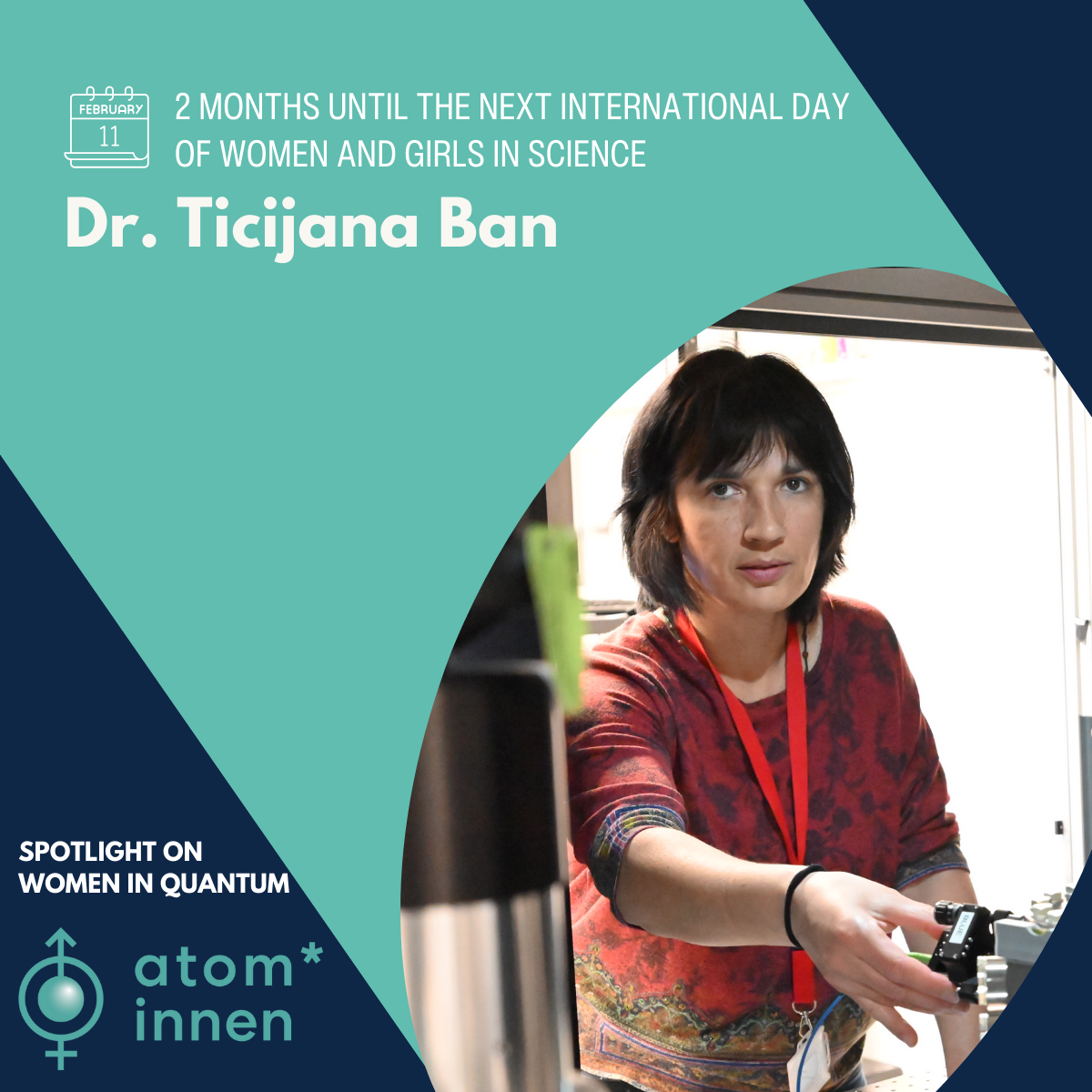
Dr. Ticijana Ban is a senior scientist at the Institute of Physics in Zagreb, Croatia, where she leads an experimental research group in the field of cold atoms. Her group conducts cutting-edge research on cold atomic gases, with a focus on topics such as frequency comb cooling of atoms, frequency comb probed cavity QED, quantum memories, and metrology. One of the group’s major ongoing initiatives is the development of a strontium optical lattice clock.
We spoke to Dr. Ban at ECAMP15 in Innsbruck about the challenges of pioneering experimental cold-atom research in Southeast Europe and building a major new research infrastructure in Croatia, as well as what motivates her in her work with students.
Dr. Ticijana Ban, thank you for taking the time to do this interview! Could you tell us what you are working on at the moment?
Currently, I am leading the Quantum Technologies Group at the Institute of Physics in Zagreb. We’re an experimental group primarily working with cold atoms for applications in metrology and quantum simulation. In addition, we conduct experiments with warm atomic vapours for quantum memory applications. Our research is supported through scientific projects, among which I highlight the QuantERA project Transport, Metastability, and Neuromorphic Applications in Quantum Networks (QNet) and the QT Flagship project Quantum Enhanced Photonic Integrated Sensors for Metrology (Quantify).
In Croatia, laser-based research is mostly concentrated at our institute in Zagreb, specifically within the Center for Advanced Laser Techniques (CALT). However, we are the only group in Croatia, and in this part of Southeastern Europe, conducting the experiments with cold atoms and optical clock. The main reason for this is that such experiments require extensive equipment and, consequently, significant funding. Beyond that, they also demand hands-on expertise and a continuous transfer of knowledge from one generation of experimental physicists to the next. Precisely because of this unique location, we are compelled to collaborate extensively with international colleagues, which allows us to discuss and share scientific ideas. At the same time, if something in the lab does not work as expected or equipment fails, we must solve these problems ourselves. In a way, this makes our students much more versatile and adaptable.
What originally sparked your interest in working with cold atoms?
I have always been fascinated by cold atom experiments, ever since my first visit to one at LENS in Florence. This inspired me to start building a cold atom experiment in Zagreb. In such experiments, you cannot simply buy a ready-made machine that produces cold atoms. Instead, everything must be built from scratch. You begin with empty optical tables and carefully assemble, component by component: lasers, optical elements, polarization elements, optical crystals, magnetic coils, atomic cells, photodetectors, electronics, vacuum systems… Gradually, you create a small kingdom where your ideas begin to come to life. That part has always fascinated me the most.
However, building cold atoms experiments from scratch requires substantial funding, so in recent years I have intensively focused on writing scientific proposals. When a proposal is positively evaluated, I lead the research both scientifically and financially. In Croatia, support for project leaders is still quite limited, and a significant amount of time is spent on project administration. I am currently participating in three EU-funded scientific projects and supervise one postdoc and four PhD students.
Thanks to your efforts, Croatia now has a major laser research center. Could you tell us more about it?
We implemented a large-scale project called the Center for Advanced Laser Techniques (CALT), which is a strategic project of the Republic of Croatia in the field of scientific infrastructure. It was funded through EU ERDF funds (European Regional Development Funds), with a budget of €16 million. It was a significant undertaking. When Croatia joined the EU, we were able to apply for infrastructure funds. It took us five years to secure the funding, during which time we had to deal with all kinds of issues: We had to deal with the pandemic, two earthquakes in Zagreb, and complicated public procurement processes. However, in 2023, we finally completed the new wing of our institute and moved in. It's fantastic, and it's made a real difference. For example, we can now see that students want to join our group and come to our institute, although we're still struggling to attract PhDs and postdocs from Western Europe as there are just so many open positions elsewhere. Nevertheless, I believe that we have transformed the scientific landscape here considerably, and I am very proud of that.
I imagine this must have been an intense experience, but ultimately also a rewarding one. What do you enjoy most about your job in general?
It's definitely a combination of many different activities. At first, it might just be about having a potential idea — something you think could be interesting to do. Then you have to write a proposal and fight for funding. After that, you have to fight for students and everything else. Then, at the end of the project, when you see that it has really worked out, it's wonderful. I particularly enjoy working with young people. You learn a lot and it's amazing to see how they grow. Of course, there will always be ups and downs, and it's not easy. But it can also be very rewarding, and I like my job very much.
You were also Croatia’s representative in the Quantum Community Network. How important do you generally think it is to have networks and collaborations?
I think networks and collaborations are essential in science, especially for early-career researchers. I always try to create opportunities for my students to connect with other labs, because it's so valuable to see how things are done elsewhere. Exposure to different approaches and ideas can really enrich your own work.
The Quantum Community Network is unique in that it connects national scientific communities with various stakeholders and funding programs in the EU. Each EU country is represented by selected members of its quantum community, whose main task is to coordinate activities and events in the quantum, ensuring the alignment of national quantum policies and funding programs with those at the EU level.
I believe that the QCN is of exceptional importance for widening countries, where the development of quantum technologies, primarily due to limited and inconsistent national funding, lags behind that of Western European countries. By being informed about upcoming EU-level initiatives, representatives from widening countries can respond more effectively towards their national authorities and lobby for alignment with EU strategies. At the same time, their participation in the QCN enables them to raise awareness among other members about the challenges they face and about the current geographical disbalance in the development of quantum technologies across Europe.
During my time in the network, we conducted a study on how well the widening countries were doing in attracting funding from EU Quantum Flagship programme.
As we found that they were not doing well, we were able to raise awareness that, if these countries cannot attract EU funding, national governments might stop supporting programs like the Quantum Technologies Flagship program, which we cannot allow to happen. The network was crucial in achieving this.
Speaking of gender: In Austria, physics is still a male-dominated field. In Croatia, we can see that more women are enrolled.
It’s true, and it’s partly due to our history. In our former social system, that is, in Yugoslavia, it was financially necessary for both parents to work. As a result, workplaces and other professional environments had a higher proportion of women, which established the norm of men and women working together. A higher proportion of women in the workforce also translates into a higher proportion of women in physics. I’m not sure, this is just my speculation. I don’t know what specific arguments I could use to support your observation, but the fact is that the percentage of women at our institute, including female students completing their theses with us, is higher than in many Western European countries.
However, things become more complicated when it comes to leadership. It's still not so common to see women in top positions, such as leaders, managers or directors.
Last question: What advice would you give to young women considering a career in quantum science?
It's difficult to offer advice, but I would say: Always do what you believe is right. You’ll win some and lose some, but you need to keep going. Do what makes you happy, what helps you grow, challenges you every day, and pushes you to keep fighting. It may sound difficult and exhausting, but life is a struggle and at the same time, it’s beautiful.
Learn more about Ticijana Ban here.
Author: Karoline Irschara
published on 2025-12-11